Observation - goldfields
Date Published
: Observers, Mining (gold fields), stereotypes
: Central Tablelands (NSW)
: Bathurst
: 1856
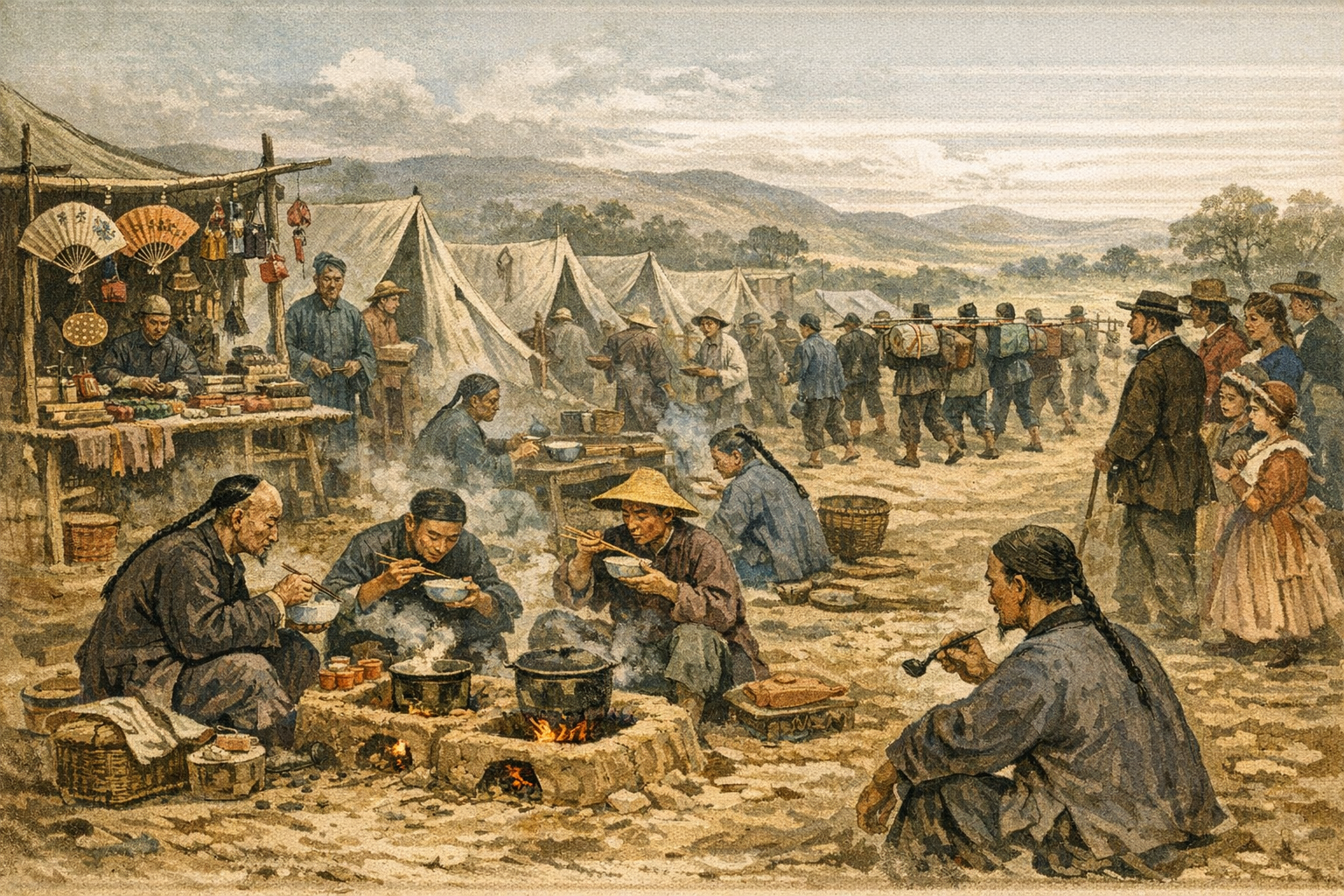
Chinese Camp at Bathurst AI generated
Amazing the yokels of Bathurst
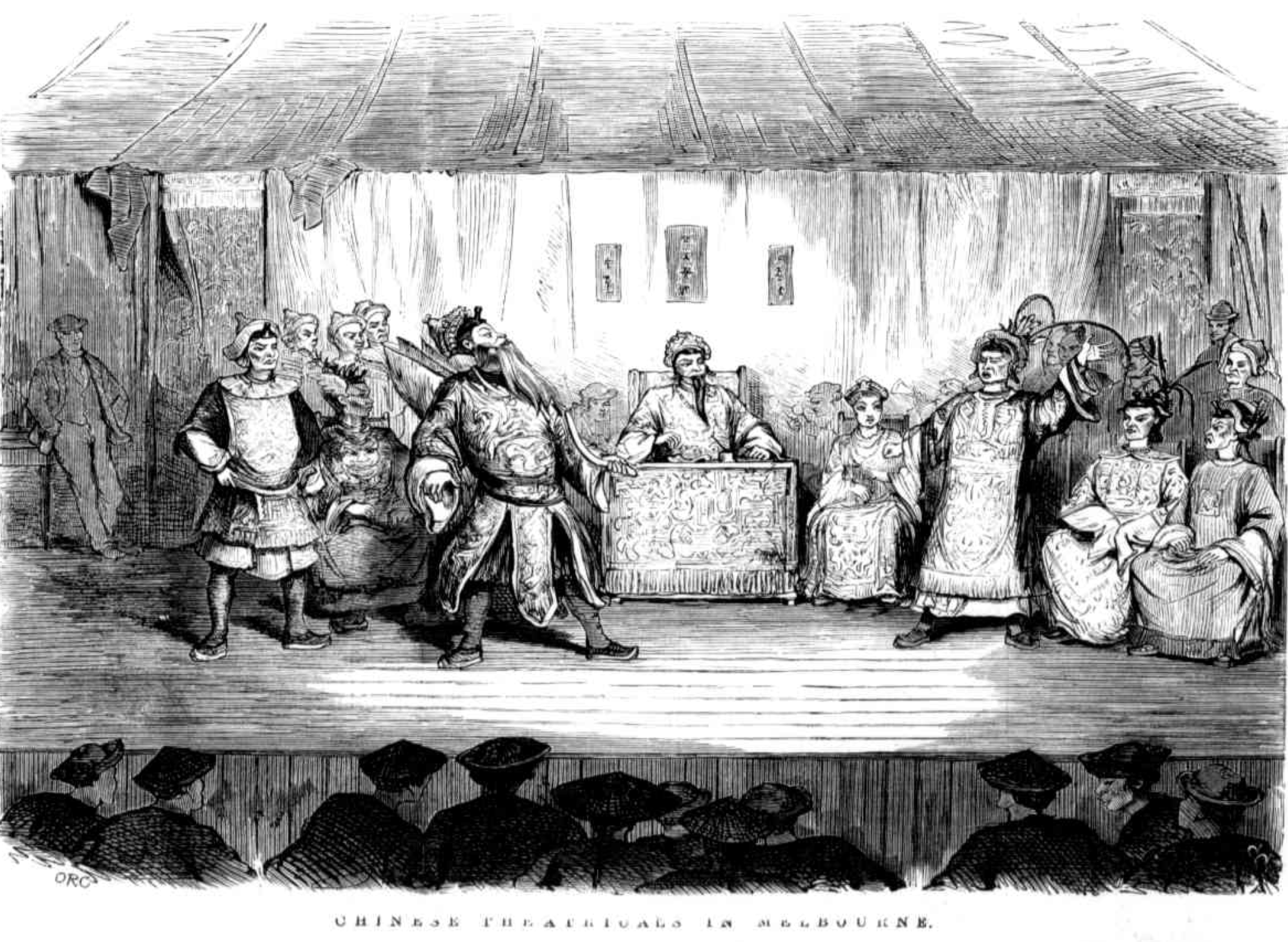
Much of the history of Chinese Australia seems to be about hostility and racism, or attempts to subvert and overcome these negatives. Yet at an early point in this contested history Chinese people were seen as simply “exotic” arrivals from a foreign land. Before the (white) locals could begin adopting stereotypes or making up reasons to reject those who were perceived as alien, they were confronted with a people who were just different. Not that such perceptions ever completely disappeared. The sheer honest amazement at Chinese culture and civilization piercing through the narrow assumptions of British/Christian superiority in accounts of Chinese Opera in 19th century Australia provide us with good illustrations of this.[1] Nevertheless, outside of these scattered examples, a pervasive smug condescension generally holds sway.
An instance of the naive impact of the sudden arrival of large numbers of people from the Qing Empire had can be see early in the NSW goldrushes. The small, relatively isolated settlement of Bathurst—only a generation after its war with the surrounding Aboriginal peoples[2]—found itself presented with some 150 Chinese men walking to the nearby goldfields. This well organised company was the cause of much excitement for the locals and crowds visited the camping area to gawk at the newcomers. An account of this spectacle gives us some idea of how things were when two groups of strangers met for the first time. A time without yet any history of antagonism or the need to throw up self-justifying prejudices or patronising dismissals.
Our diggings promise to become the sites of a series of Chinese colonies. A few days ago a second batch of the sons of the Celestial Empire arrived in Bathurst, consisting, as nearly as we can guess, of about 150, and proceeded to the camping ground of their predecessors, where they pitched their tents, spread their mats, and commenced cooking — , favourite pastime apparently, which, together with eating, seems to swallow up the whole day. Amongst their number we perceived several rather ancient looking pig-tails, who, in all probability, have come to deposit their bones in Australia. Their canvass village has been a favourite resort for the townspeople, who have thronged in front of their tents to witness the novelty of their proceedings, amongst which the expert use of their chopsticks was not the least amusing. Their economical use of firewood was another circumstance which called forth the astonishment of the visitors, who saw that by digging small holes in the ground, with ventilation only in front, that about as much timber was consumed in boiling and stewing for 150 as would cook a meal for a single family, after our own fashion. There was the usual display of fans and purses, and other trifles for sale, but the exorbitant prices asked reduced their traffic almost to nil. On Monday last they struck their tents, and trotted off to the westward with their stock of domestic utensils, mats, and bedding, slung upon poles.[3]
There is little here of the fear and loathing or the heavy patronising tone that would become commonplace. On the other hand, there is also no hint that practices observed, such as reducing the consumption of firewood, might be worth imitating. The arrival of this group is an interesting but not yet threatening spectacle. But also it is not one that could impinge upon the habits and prejudices brought ready-made from Europe. The scene is set, therefore, for that ‘othering’ which would make up so much of subsequent Chinese Australian history.
[1] For example, Local Intelligence – Chinese Opera, Ovens and Murray Advertiser, 7 March 1863, p.2, where the critic is both ‘astonished and pleased’. For more on Chinese Opera in Australia see “Smoking opium, puffing cigars, and drinking gingerbeer: Chinese Opera in Australia”.
[2] See, Stephen Gapps, Gudyarra: The First Wiradyuri War of Resistance — The Bathurst War, 1822–1824.
[3] Bathurst Free Press and Mining Journal, 30 July 1856, p.2. Thanks to Juanita Kwok for spotting this gem, quoted in Juanita Kwok, The Chinese in Bathurst: Recovering Forgotten Histories, Doctoral thesis, Charles Sturt University, Bathurst, 2018.